Lightning, investigated since Benjamin Franklin’s first research in 1749, has paradoxically become a growing threat to our highly electronic society.
A lightning flash is generated between two zones of opposite charge, typically between two storm clouds or between one cloud and the ground.
The flash may travel several miles, advancing toward the ground in successive leaps: the leader creates a highly ionized channel. When it reaches the ground, the real flash or return stroke takes place. A current in the tens of thousands of Amperes will then travel from ground to cloud or vice versa via the ionized channel.
At the moment of discharge there is an impulse current flow that ranges from 1,000 to 200,000 Amperes peak, with a rise time of about a few microseconds. This direct effect is a small factor in damage to electric and electronic systems, because it is highly localized.
The best protection is still the classic lightning rod or Lightning Protection System (LPS), designed to capture the discharge current and conduct it to a particular point.
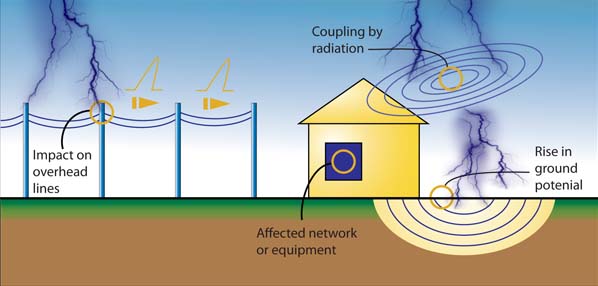
There are three types of indirect lightning effects:
Such lines are very exposed and may be struck directly by lightning, which will first partially or completely destroy the cables, and then cause high surge voltages that travel naturally along the conductors to line-connected equipment. The extent of the damage depends on the distance between the strike and the equipment.
The flow of lightning in the ground causes earth potential increases that vary according to the current intensity and the local earth impedance. In an installation that may be connected to several grounds (e.g. link between buildings), a strike will cause a very large potential difference and equipment connected to the affected networks will be destroyed or severely disrupted.
The flash may be regarded as an antenna several miles high carrying an impulse current of several tenths of kilo-amperes, radiating intense electromagnetic fields (several kV/m at more than 1km). These fields induce strong voltages and currents in lines near or on equipment. The values depend on the distance from the flash and the properties of the link.
An industrial surge covers a phenomena caused by switching electrical power sources on or off.
Industrial surges are caused by:
 Starting motors or transformers Starting motors or transformers
Neon and sodium light starters
Switching power networks
Switch “bounce” in an inductive circuit
Operation of fuses and circuit breakers
Falling power lines
Poor or intermittent contacts
These phenomena generate transients of several kV with rise times of the order of the microsecond, disturbing equipment in networks to which the source of disturbance is connected.
Electrically, a human being has a capacitance ranging from 100 to 300 picofarads, and can pick up a charge of as much as 15kV by walking on carpet, then touch some conducting object and be discharged in a few microseconds, with a current of about ten Amperes. All integrated circuits (CMOS, etc.) are quite vulnerable to this kind of disturbance, which is generally eliminated by shielding and grounding.
Overvoltages have many types of effects on electronic equipment in order of decreasing importance:
Destruction:
Voltage breakdown of semiconductor junctions
Destruction of bonding of components
Destruction of tracks of PCBs or contacts
Destruction of triacs/thyristors by dV/dt
Interference with operations:
Random operation of latches, thyristors, and triacs
Erasure of memory
Program errors or crashes
Data and transmission errors
Components exposed to overvoltages have a shorter life.
The Surge Protection Device (SPD) is a recognized and effective solution to solve the overvoltage problem. For greatest effect, however, it must be chosen according to the risk of the application and installed in accordance with the rules of the art.
|